
FIELD NOTES: The Elusive Backyard Woodpecker
You might hear a pileated woodpecker before you ever see one. But even when one visits our backyard, capturing it on camera can be a challenge.
Our footage was recorded on two different days in Palm Harbor, Florida. These striking birds don't seem interested in having an audience. Once they notice they're being watched, they're often gone before we can capture them hard at work.
Fortunately, even a brief encounter gives us plenty to explore. Here are three fascinating facts about this remarkable bird:
Fact #1: A Giant Among Woodpeckers
The pileated woodpecker is the largest living woodpecker in North America, measuring approximately 16–19 inches long, with a wingspan that can reach nearly 30 inches.
With its brilliant red crest, bold black-and-white markings, and impressive size, it's hard to mistake this bird for anything else.
But there's something even more remarkable about its size: the powerful bill it uses to excavate wood in search of insects, particularly carpenter ants.
Those excavations can leave large, rectangular holes in trees—sometimes providing the first clue that a pileated woodpecker has been visiting.
Fact #2: The Homes They Leave Behind
Pileated woodpeckers aren't just impressive excavators. They're also important contributors to forest ecosystems.
Using their powerful bills, they carve large cavities into dead or decaying trees. Some are created while searching for insects, while others are excavated specifically for nesting.
And here's where things get interesting!
Once a nesting cavity is abandoned, it can become valuable shelter for other wildlife, including wood ducks, owls, squirrels, and other cavity-nesting animals.
In other words, the pileated woodpecker doesn't just make a home for itself. Its handiwork can benefit other forest residents long after it moves on.
Fact #3: Built for the Hammering
Imagine repeatedly striking a tree with your face! For a pileated woodpecker, that's just another day at work.
These remarkable birds have specialized adaptations that help them withstand the forces generated by repeated pecking.
Research on woodpeckers has documented impact decelerations ranging from approximately 600 to 1,500 times the acceleration of gravity. Their small brains and specialized anatomy help them tolerate these extraordinary impacts.
Their strong neck muscles, reinforced skull structures, and specialized beaks help them deliver powerful blows while excavating wood. Their brains are also relatively small and positioned within the skull in ways that may help reduce certain mechanical stresses.
But there's an important scientific distinction: woodpeckers aren't necessarily immune to brain injuries. Researchers continue to study how their anatomy handles repeated impacts.
And those incredible pecking abilities serve a purpose. Pileated woodpeckers use their powerful bills to uncover insects, excavate nesting cavities, and communicate by drumming.
Perhaps being hard-headed isn't always a bad thing! 😂
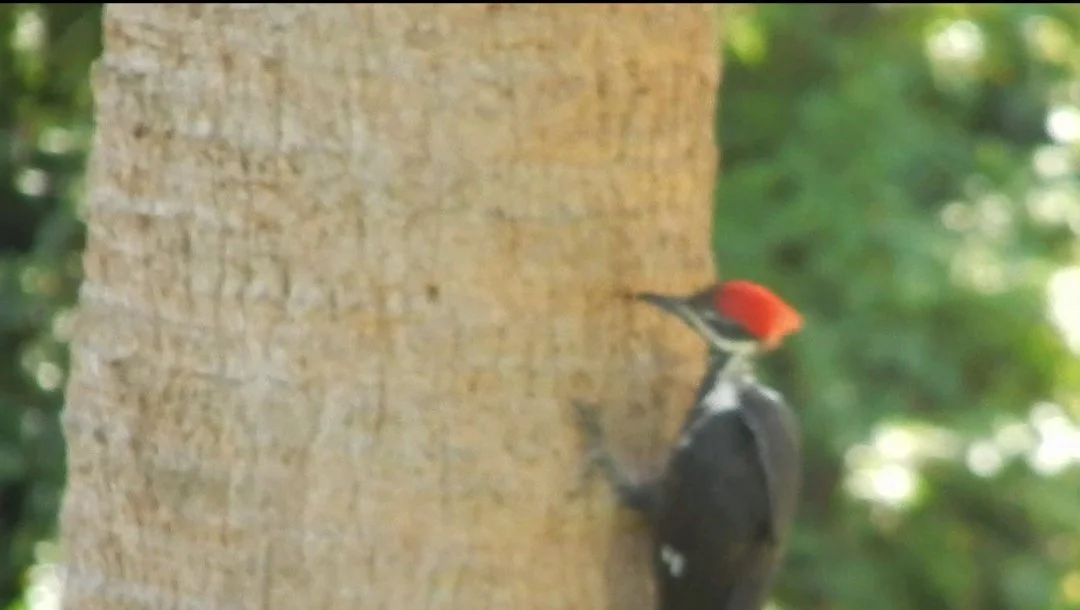
Pileated Woodpecker
The Pileated Woodpecker video: Three interesting facts.
